
“Thank you for putting your phones away I know it’s annoying” - Phoebe Bridgers IN DC
BY EMMALEE SULLIVAN
On September 29th, Phoebe Bridgers brought her Lost Weekend tour to Capital One Arena in Washington, DC. You know how much this show meant to me when I called my dad to tell him Alex G was opening for Phoebe Bridgers, and his genuine response was, “Oh my gosh!”
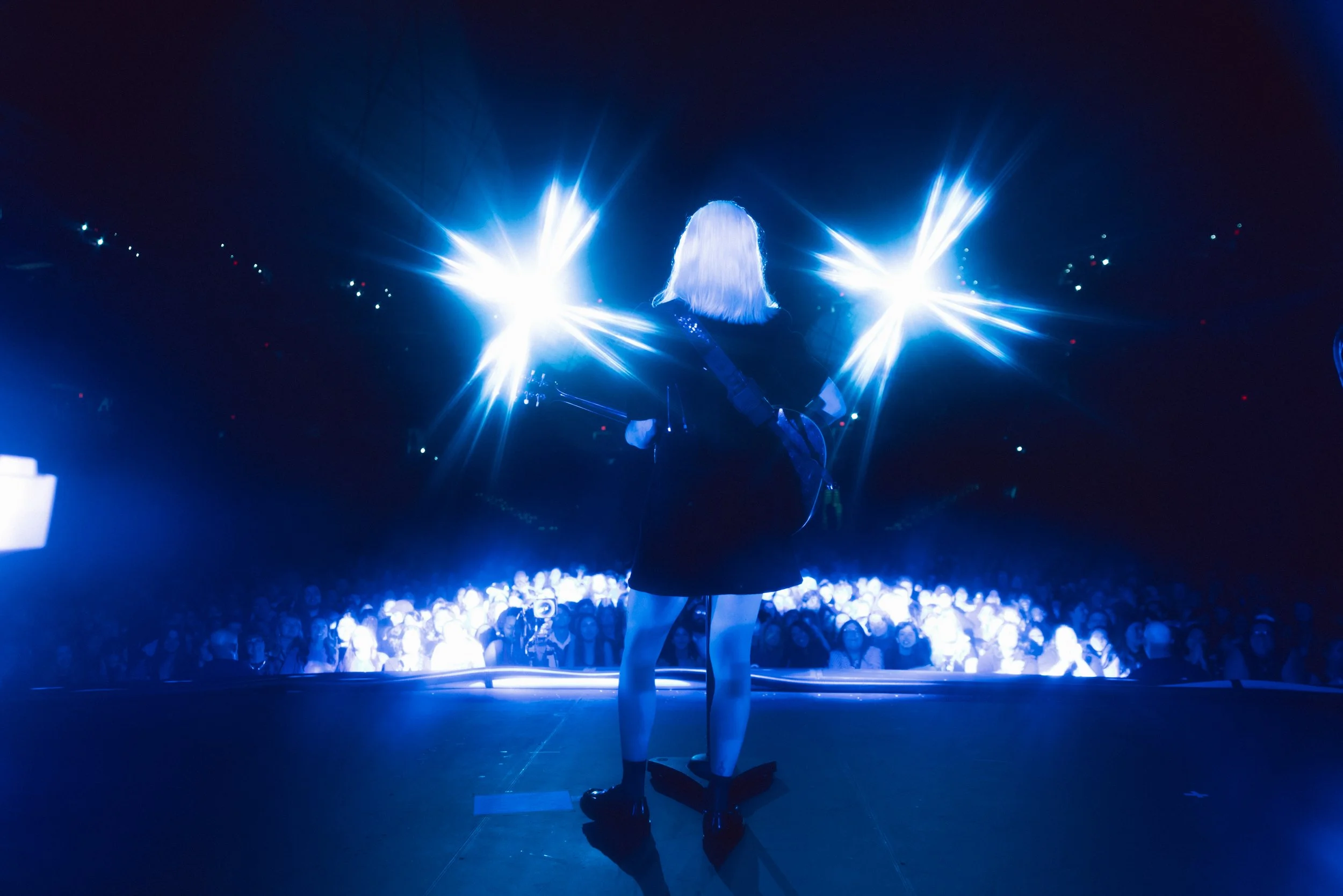
PHOTO BY WES ELLIS | @ATWES
The excitement was obvious before I even entered the arena. Outside, hundreds, if not thousands, of fans stood in line wearing wristbands, many of whom had arrived as early as 8 a.m. to secure a spot as close to Phoebe as possible. The crowd looked like a collection of characters from the Phoebe Bridgers universe: fans in alien costumes, Jesus outfits, completely blue body paint, and, of course, thousands of skeletons representing her last solo album, Punisher.
I have been to a few phone-free shows before, but never one in an arena, and I was especially curious to see how the policy would affect a venue of this size. Videos of fans drawing the stage and lighting design had already given me an idea of what to expect, but seeing it in person was completely different.
When I reached my seat, I was greeted by a large igloo-like, half-disco-ball stage on one side of the arena and a circular B-stage with a massive black comet suspended above it. Even the pre-show atmosphere felt intentionally different. Instead of the usual loud playlist and restless crowd waiting for the opening act, calming, mysterious music with very limited lyrics filled the arena.
Normally, this is the part of a concert where my nerves are at their highest. Fans are pushing toward the barricade, music is blasting, and people are pulling up setlists on their phones before the artist even walks onstage. Here, I watched fans calmly make their way toward the barricade while talking to their friends. The lack of phones didn't make the arena feel less energetic; it made it feel more present.
At around 7:30 p.m., Alex G took the B-stage, opening with “June Guitar.” I’ve seen Alex G three times now, and not once has he disappointed me. His smaller stage felt almost perfectly suited to his set: no projections, no elaborate production, just a circle of lights and Alex G doing what he does best.
He brought out all the tricks (pun intended), moving from accordion to screamo moments before settling into fan favorites like “Kute,” “Mary,” and “Sarah.” Hardcore Alex G fans know that he rarely plays some of his biggest songs, which made every recognizable opening note feel like its own event.
Then came “Mis.”
I have waited years to hear this song live, and it is one of my favorite songs of all time. Alex rarely performs it when he comes to DC, so when I recognized the opening note, I genuinely began to tear up. I had to physically pinch myself to prove I wasn't imagining it.
After the set, Alex walked offstage with almost no ceremony, leaving me sitting in my seat trying to process what had just happened. I thought about how hard I had searched for Rocket and Trick on vinyl, eventually finding both in a little store in Indiana and feeling completely untouchable. And somehow, after all of that, I was still left waiting for the day Alex decides to play my all-time favorite song of his, “Bobby,” in DC.
Then, at 9 p.m., the lights went down.
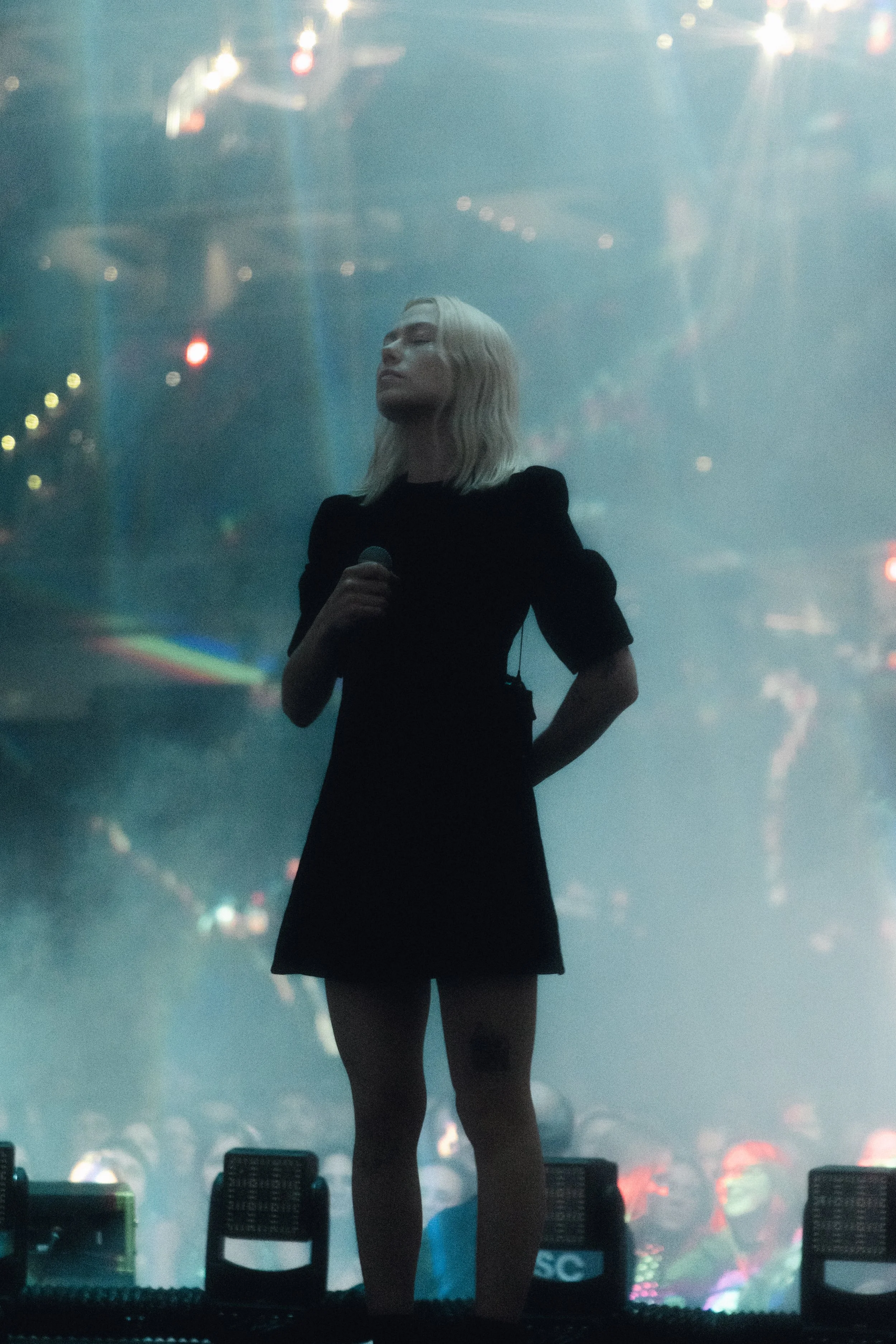
PHOTO BY WES ELLIS | @ATWES
The black comet that had been hanging over the stage began glowing blue and green as “The Outside” filled the arena. The white stage cover lifted, revealing Phoebe ripping into “Motion Sickness” on guitar. Even from my seat, her green glitter tear makeup caught the light.
From there, the production became part of the storytelling.
During “Kill Me,” my favorite song from Lost Weekend, white lighting moved across the audience like a soft wave, making the crowd feel less like spectators and more like another element of the performance. During “Lost Boys,” Phoebe pointed out that she wrote the song with Alex G, which felt particularly fitting after his opening set; his influence is easy to hear in the song's energy and composition.
The projections throughout the show were another detail that stood out. Rather than relying entirely on giant LED screens, Phoebe was projected onto large curtains surrounding the stage. I had noticed a similar effect at Hayley Williams’ show, and I was excited to see it used here. The curtains made the projections feel softer and more intimate. Instead of screaming, “HEY, PEOPLE IN THE BACK,” they felt like part of the world Phoebe had created onstage.
Halfway through the set, Phoebe disappeared before reappearing on the B-stage to perform “Panorama” on a floor piano. Then came “Lost Weekend,” accompanied by some of the most difficult-to-describe lighting of the night.
White and silver rods shot out from the comet above the stage, creating holographic tones that looked almost like electricity running through the arena. The effect was disorienting in the best way, the kind of visual overload I would imagine some crazy drug could create, thankfully achieved through lighting, music, and Phoebe Bridgers’ creative brain.
The stage itself slowly rotated throughout the performance, constantly changing the audience's view of Phoebe. Whether it was designed to give everyone in the arena a different perspective or simply to contribute to the surreal flow of the show, it worked. Nothing felt static.
The show eventually shifted from spectacle to something much more personal.
“Does anyone have a complicated relationship with their parents?” Phoebe asked while transitioning into her next song. She spoke about having an abusive father with whom she had a confusing relationship, but ultimately being distraught when he passed away. She then connected the conversation to the current political climate, saying, “Trump is kinda like all of our abusive dad,” before alluding to how she would not be upset if he…left.
It was one of several moments where Phoebe brought the audience back down to earth after the larger-than-life production surrounding her.
Later, she made her way back to the main stage by walking directly through the crowd, stopping to give fans high-fives and small hugs. After spending much of the show surrounded by massive lighting fixtures, projections, and a rotating stage, seeing her physically move through the audience created an entirely different kind of connection.
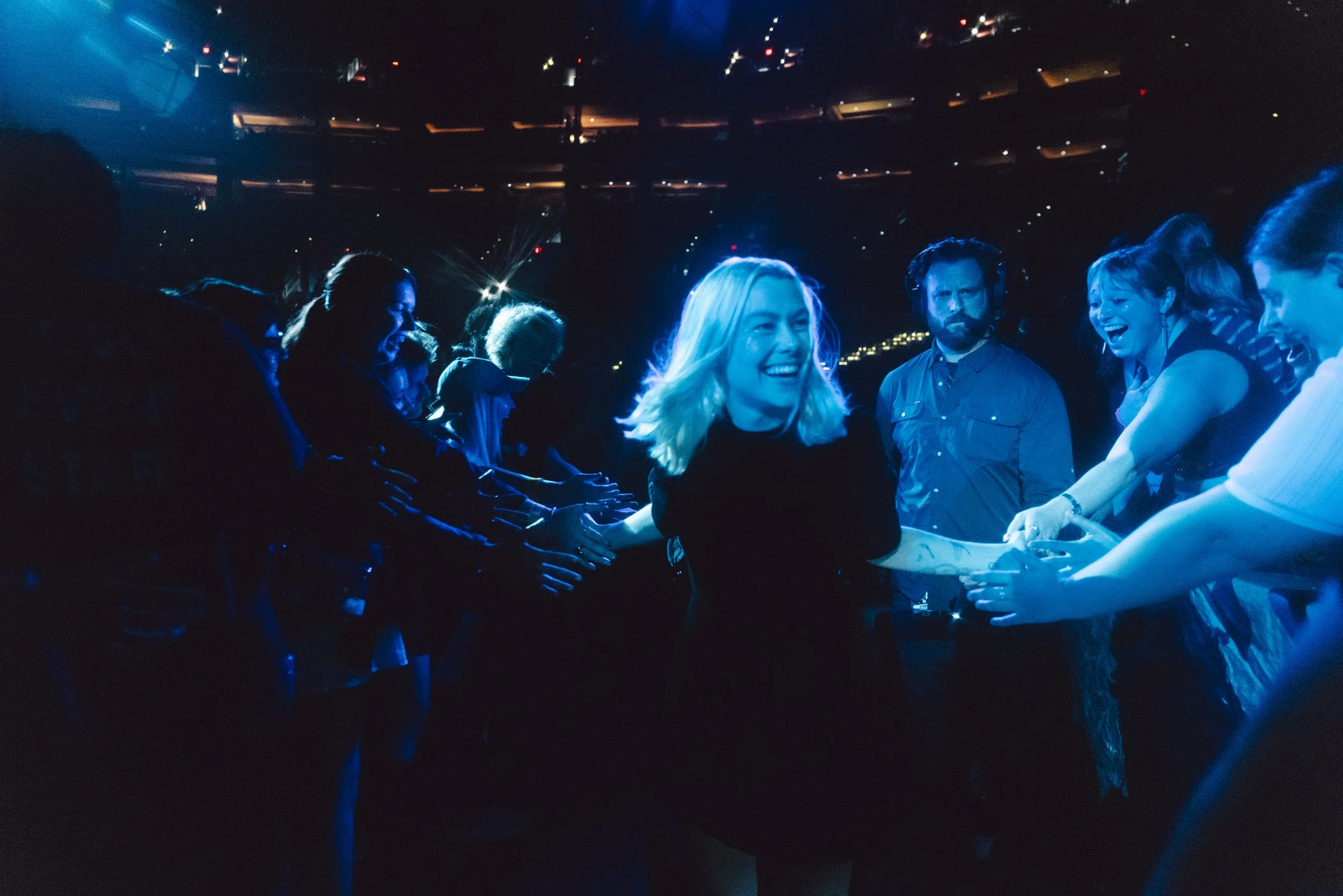
PHOTO BY WES ELLIS | @ATWES
After performing “Bobby” and “Georgia,” along with a lovely guest appearance from her brother Jackson to perform “I Can’t Wait,” fans were gripping the barricade on their toes, anxiously waiting to hear what DC’s surprise song would be.
Then Phoebe began singing, “I’ve been running around in circles…” AND The entire arena erupted.
We got the tour debut of “Chinese Satellite,” a favorite among many listeners. Looking down into the pit, my eye was drawn to what appeared to be a father running around, dancing and throwing his arms into the air. I have always loved the song, so hearing it live for the second time, four years after I first heard it, was another unexpected highlight.
Then came the moment that best represented what made this show different: “I Know the End.”
Hearing 20,000 people scream the lyrics together was already surreal, but the final scream felt almost therapeutic. There was no recording it, no posting it, no saving it for later. Everyone in the arena was experiencing the same moment at the same time.
I got emotional during the song. Maybe it was the intensity of sharing that moment with 20,000 other people. Maybe it was the release of being able to scream at the top of my lungs about things in my own life. Either way, there are few artists who can create that kind of reaction from me.
“I Know the End” also served as a warning that the night was coming to a close.
The spaceship landed over the band once more as the arena cheered for Phoebe to return and break our hearts one last time. She eventually appeared on the B-stage in a white dress, surrounded by a sharp blue laser that made it look as though a spaceship was descending from the sky to take her away. A “tractor beam, coming to take me to where I’m from.”
Then came “Scott Street.”
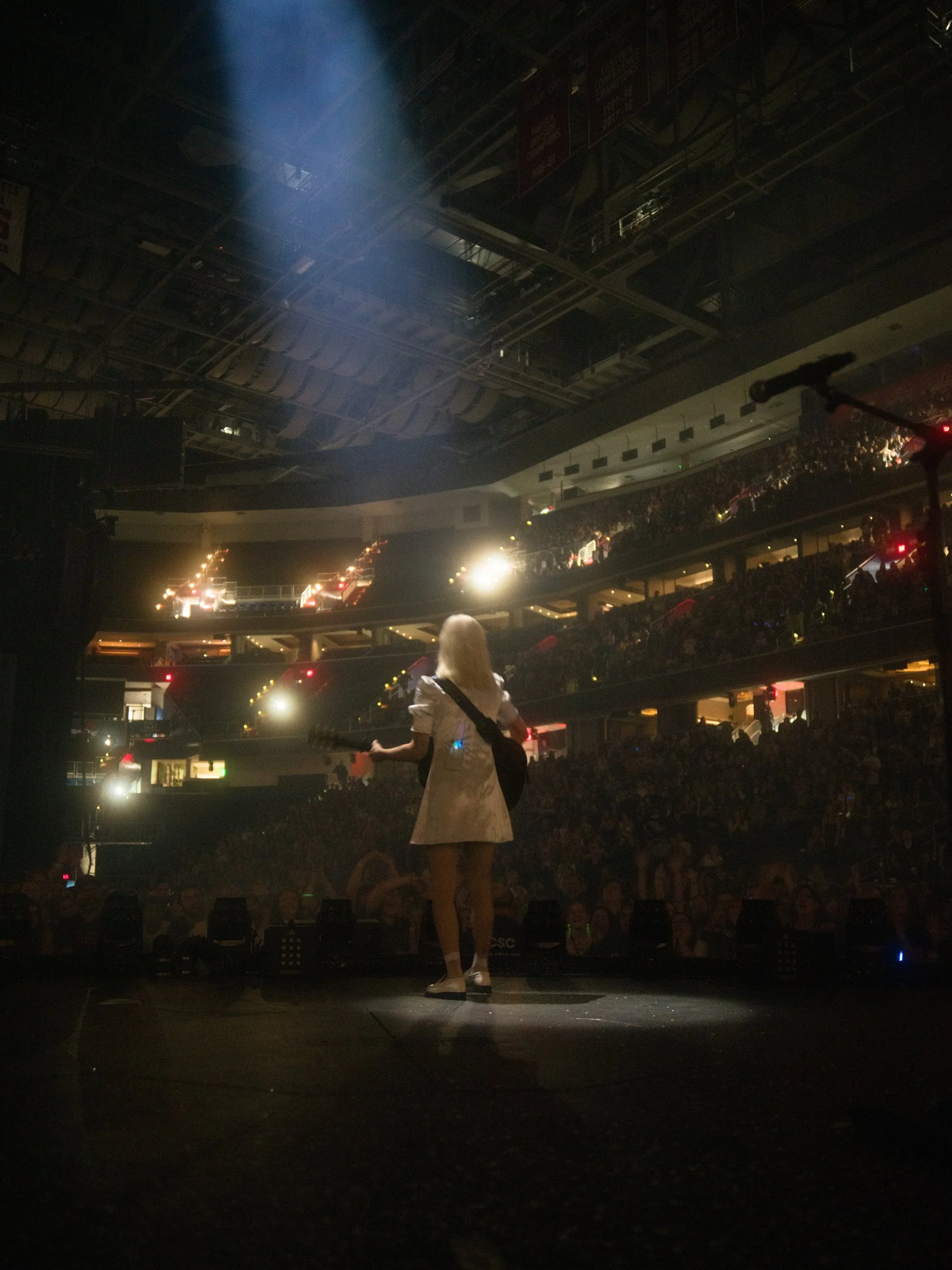
PHOTO BY Matt Grubb | @mattgrubb.americas.waffle
The arena lights came up so brightly that you could see faces from the nosebleeds all the way down to the pit. Slowly, thousands of people lifted their hands and began swaying together.
I had never seen anything quite like it. No phones. No one trying to capture the perfect video. No one watching the show through a screen. Just thousands of people swaying to a song that clearly meant something to them.
For once, I wasn't thinking about getting to the Metro on time. I wasn't wondering what email might be waiting on my phone. I wasn't worrying about getting the perfect photo. I was just there.
At the very end of the song, Phoebe said, “Thank you for putting your phones away, I know it’s annoying.” I don't think anyone in that arena was thinking about how annoying it was.
As the night officially came to an end, the band played “Never Going Back!” while Phoebe returned to the barricade to sign a few items for fans. Walking home, I realized I felt unusually fulfilled. That isn't always how I leave a concert. Too often, I'm trying to see around someone's head, watching a performance through the phone held directly in front of me, or thinking about whether I captured enough content to remember the night.
If I had to describe Phoebe Bridgers’ Washington, DC show in one word, it would be personal.
The phone-free policy did more than keep people from recording. It changed the relationship between the audience and the performance. Without the constant pressure to capture, post, or document the night, the audience was given permission to simply experience it. I did bring a physical pen and paper to write down key moments throughout the shoW, which I will say is quite difficult to do in the dark, but otherwise, I found myself wishing more concerts were phone-free.
Phoebe Bridgers created something that is becoming increasingly difficult to find at a concert: a room full of people who were completely present. In an industry where live music is increasingly experienced through screens before the show is even over, Lost Weekend reminded me why I fell in love with concerts in the first place. For a few hours, there was no need to capture anything. The experience itself was enough.
The Lost Weekend U.S. tour has just under a month left. And if the Washington, DC show was any indication, Phoebe Bridgers has created a concert experience that is best understood not through a video, photo, or social media post, but by simply being there.
